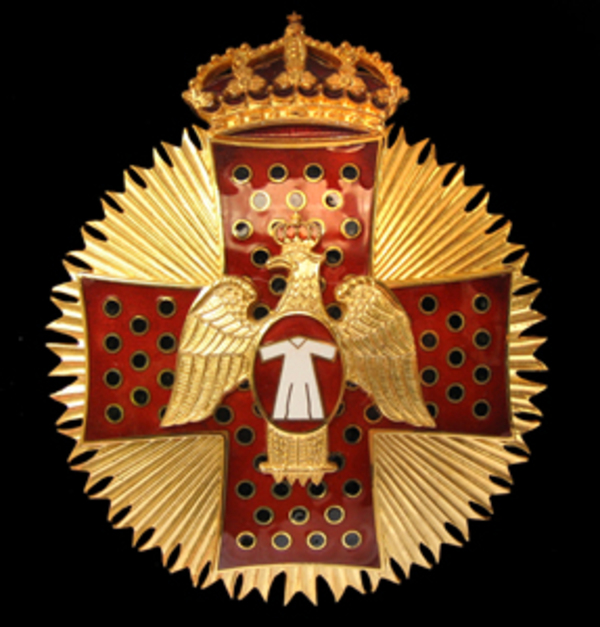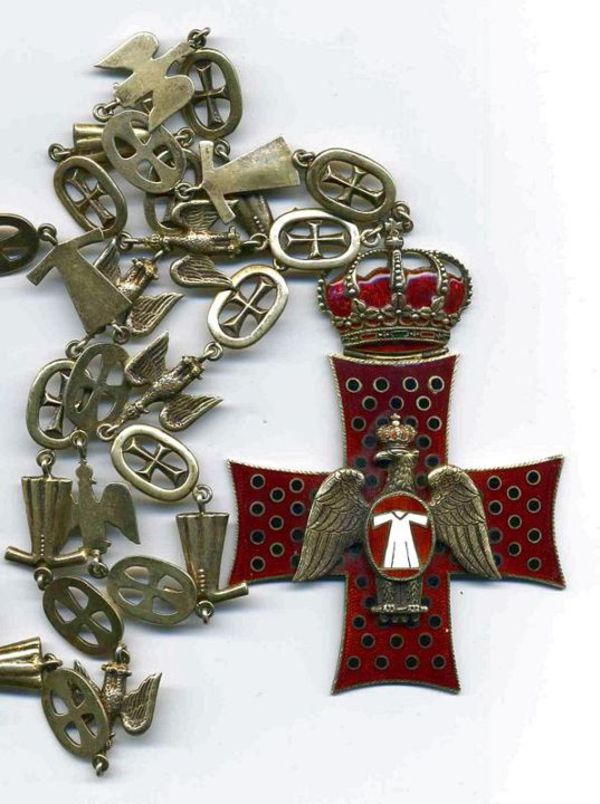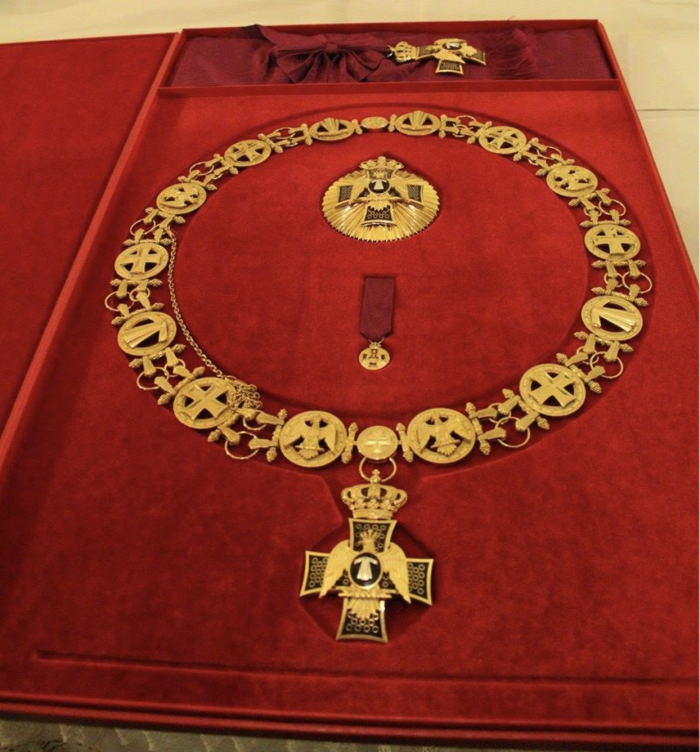
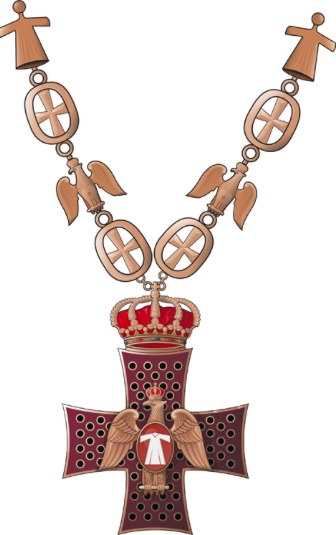
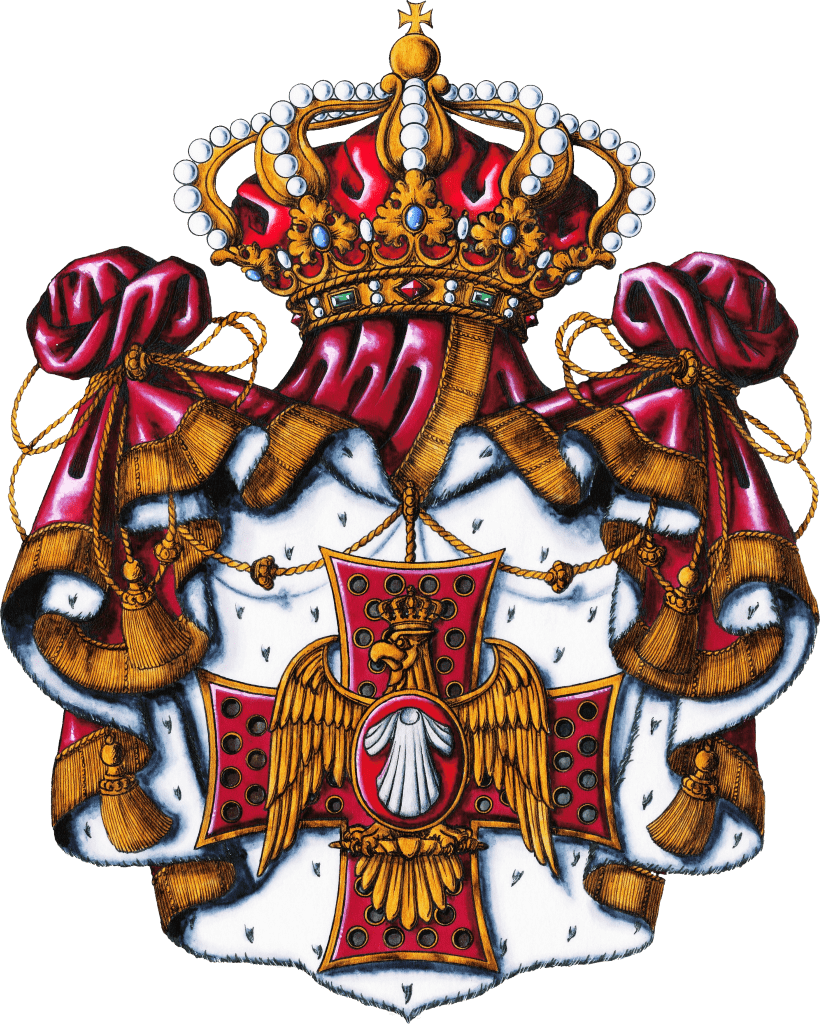
The Order of the Eagle of Georgia and the Seamless Tunic of Our Lord Jesus Christ, commonly known as the Order of the Eagle of Georgia, is the premier dynastic order of chivalry of the Royal House of Georgia.
The Order operates under the authority of His Royal Highness Prince Davit Bagration of Mukhrani, Head of the Royal House of Georgia, who has served as Sovereign Grand Master of the Order since 2008. It unites the historical and dynastic traditions of the Georgian monarchy with a modern commitment to service, humanitarian action, personal integrity, support for Georgia and the Royal House, and the promotion of Georgian history, culture, and traditions to a wider public.
Origins in Georgian Tradition
According to the tradition preserved by the Royal House of Georgia, the origins of the Order are associated with the reign of Saint Queen Tamar, who ruled Georgia from 1184 to 1213 during the period remembered as the Georgian Golden Age.
The traditional account holds that Queen Tamar constituted an order of knights in connection with Georgian support for the Empire of Trebizond. The Order was placed under the spiritual and national symbolism of the Seamless Tunic of Our Lord Jesus Christ, one of the most important sacred traditions associated with Georgia.
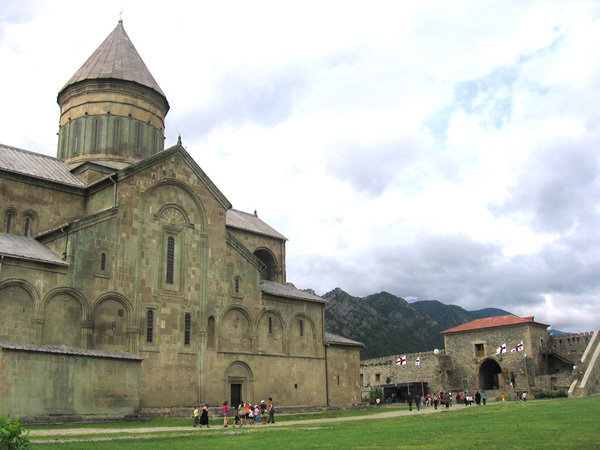
According to Georgian tradition, the Tunic worn by Christ before the Crucifixion was brought to Georgia after lots were cast for it by the Roman soldiers. The relic became associated with Mtskheta and with Svetitskhoveli Cathedral, one of the most sacred and historically important places in Georgia.
The full name of the Order therefore connects it with the Christian heritage of Georgia, the history of the Georgian monarchy, and the traditions of the Royal House of Bagration.
The Bagrationi dynasty also preserves an ancient dynastic tradition tracing its ancestry to the biblical Kings David and Solomon. This tradition has long formed part of the religious and historical identity of the Georgian Royal House.
These medieval and sacred traditions provide the historical foundation claimed for the Order by the Royal House. Its documented modern existence, however, begins with its reconstitution in the twentieth century.
The Modern Reconstitution of 1939
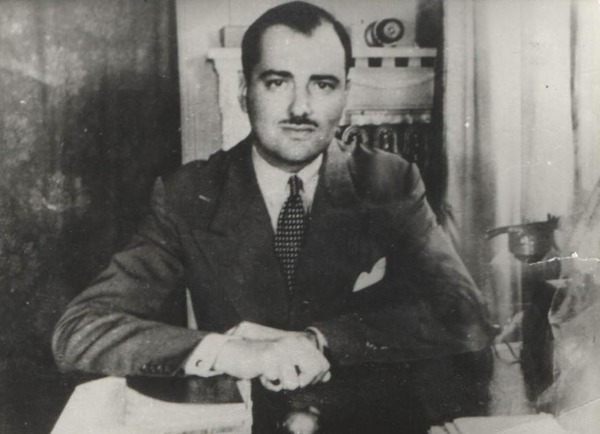
The Order was reconstituted in 1939 by His Royal Highness Prince Irakli Bagration of Mukhrani, grandfather of the present Head of the Royal House. Prince Irakli established it as the principal dynastic order of the Royal House of Georgia.
During Prince Irakli’s Grand Mastership, admission was highly selective. The Order was conferred primarily upon members of the Georgian Royal Family, members of other royal and imperial houses, senior nobles, trusted associates of the Royal House, and distinguished individuals who had rendered exceptional service to Georgia, the monarchy, or the Head of the Royal House.
The Order was not intended merely as a ceremonial distinction. From its modern reconstitution, it was closely connected with the preservation of Georgian national identity, the defense of the rights of the Royal House, and the eventual restoration of an independent Georgian state under a constitutional monarchy.
Prince Irakli and the Union of Traditionalist Georgians
In 1942, Prince Irakli was elected President of the Union of Traditionalist Georgians by prominent Georgian leaders living in exile.
Members and supporters of the Union included Zurab Avalishvili, Mikheil Tsereteli, Grigol Robakidze, Kita Chkhenkeli, Shalva Maglakelidze, Shalva Amirejibi, Spiridon Kedia, Markoz Tugushi, Giorgi Kvinitadze, Leo Kereselidze, Revaz Gabashvili, Davit Vachnadze, Alexandre Asatiani, Svimon Tsitsishvili, and other notable representatives of Georgian political, military, intellectual, and cultural life who had been forced into exile following the Soviet invasion and occupation of Georgia.
The principal objectives of the Union were the restoration of Georgia’s independence and the establishment of a constitutional monarchy.
At a time when much of Europe was dominated by totalitarian ideologies, the Union’s support for an independent, national, democratic, and constitutional Georgian monarchy represented a distinct political and institutional vision for the future of the country.
Dynastic Continuity
Prince Irakli married Maria Antonietta Pasquini of the Counts of Costafiorita in Rome on 20 June 1940. Their son, Prince Giorgi Bagration of Mukhrani, would later succeed his father as Head of the Royal House and Sovereign Grand Master of the Order.
This dynastic continuity was important to the Order because the Grand Mastership remained inseparably connected to the Headship of the Royal House of Georgia.
Distinction from the Order of Saint Queen Tamar
The Order of the Eagle of Georgia should not be confused with the separate Order of Saint Queen Tamar.
The latter originated as a military distinction associated with the Georgian Legion in 1915 and was subsequently recognized by the Democratic Republic of Georgia in 1918. It was suppressed following the Soviet occupation of Georgia.
Prince Irakli treated the Order of Saint Queen Tamar as a distinct Georgian national institution rather than as another name for the Order of the Eagle of Georgia. The two Orders have separate histories, identities, and regulations.
The Order of Saint Queen Tamar was later returned to active use within the chivalric heritage of the Royal House by Prince Davit.
Read the history of the Order of Saint Queen Tamar.
The Grand Mastership of Prince Giorgi
Upon the death of Prince Irakli in 1977, he was succeeded as Head of the Royal House and Sovereign Grand Master by his son, His Royal Highness Prince Giorgi Bagration of Mukhrani.
Prince Giorgi had been raised in exile in Spain, having arrived there during infancy. His life combined his responsibilities as Head of the Royal House with professional and public responsibilities in Spain.
For reasons of discretion and dynastic policy, Prince Giorgi initially maintained the Order within a restricted circle. The Order was primarily conferred to members of the Royal Family, other dynasts, senior nobles, close associates of the Royal House, and exceptional persons of recognized merit.
The Return of the Royal Family to Georgia
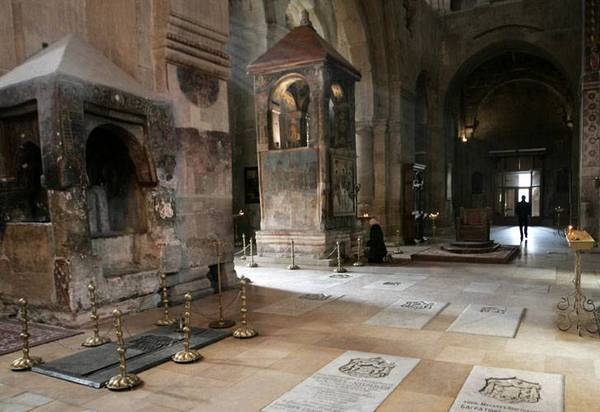
In 1995, Prince Giorgi arranged for the remains of his grandparents, Prince Giorgi Bagration and Princess Elene Bagration, to be transferred to Georgia and interred at Svetitskhoveli Cathedral. The funeral and reinterment were conducted with state honors and with the participation of the Catholicos-Patriarch of All Georgia.
During that visit, President Eduard Shevardnadze received Prince Giorgi and reportedly told him:
“My Lord, you are in your home. We need the Royal Family for the unity of the country.”
The Royal House records that Prince Giorgi was received in Georgia as Head of the Royal House and heir to the historical Crown. The restoration of Georgian citizenship to members of the Royal Family further strengthened the formal connection between the dynasty and its homeland following decades of exile and Soviet occupation.
Opening the Order to Distinguished Service
In 2001, Prince Giorgi began admitting a broader range of qualified candidates to the Order. Although admission remained selective, membership was no longer confined almost exclusively to dynasts, senior nobility, and the closest associates of the Royal House.
The Order was increasingly used to recognize individuals distinguished by excellence, merit, service to Georgia, humanitarian work, cultural contribution, or support for the Royal House and the Georgian national cause.
On 23 November 2003, Prince Giorgi issued new statutes adapting the administration and operation of the Order to contemporary circumstances. These regulations helped establish the structure through which the Order would later develop internationally.
Prince Giorgi consistently intended the Order to serve as an effective instrument of assistance to the Georgian people, rather than existing only as a ceremonial or honorific institution.
Return to Permanent Residence in Georgia
In 2005, Prince Giorgi settled permanently in Tbilisi. The Royal House regards him as the de jure King Giorgi XIII of Georgia.
His return represented an important moment in the modern history of the dynasty. After generations of foreign domination, exile, and Soviet rule, the Head of the Royal House once again resided in Georgia.
The Constitutional Monarchy Debate
On 7 October 2007, His Holiness and Beatitude Catholicos-Patriarch Ilia II publicly called upon Georgia to consider the restoration of a constitutional monarchy under the Bagrationi dynasty.
The Patriarch presented constitutional monarchy as a potential source of national unity, continuity, and stability. His public statement produced widespread political and public discussion concerning the future constitutional organization of Georgia and the possible role of the Royal House.
Prince Giorgi recognized that the long-term dynastic mission would need to be undertaken by a younger generation with direct knowledge of modern Georgian society and public life.
The Succession of Prince Davit
Prince Giorgi died in Tbilisi on 16 January 2008. In accordance with his designation and the dynastic traditions of the Royal House, he was succeeded by his son, His Royal Highness Prince Davit Bagration of Mukhrani.
Since succeeding his father in 2008, Prince Davit has served as Head of the Royal House of Georgia and Sovereign Grand Master of the Order of the Eagle of Georgia.
Under Prince Davit’s leadership, the Order entered a new period of international organization, institutional development, charitable activity, and public engagement.
The International Development of the Order
Prince Davit confirmed the continued operation of the Order and strengthened its administrative structure. Rectories and other regional bodies were established or renewed in countries and regions throughout Europe, the Americas, Asia, and other parts of the world.
These Rectories operate in accordance with the laws of their respective jurisdictions while remaining subject to the authority of the Sovereign Grand Master and the Royal House of Georgia.
The Order’s official documentation was also modernized. Diplomas that had previously been issued principally in French began to be prepared in Georgian and in other widely used languages, including English, French, and Spanish.
In April 2025, Prince Davit approved a comprehensive framework governing the purpose, structure, admission standards, responsibilities, privileges, and administration of the Order. That framework supersedes earlier regulations on the matters it addresses while preserving established customs where the new framework is silent.
Notable Historical Membership
Throughout its modern history, the Order has been conferred upon members of royal and imperial houses, senior religious leaders, statesmen, diplomats, military officers, humanitarians, and individuals distinguished by their service.
During the Grand Mastership of Prince Irakli, members included, among others:
- Grand Duke Vladimir Kirillovich of Russia
- King Umberto II of Italy
- King Boris III of Bulgaria
- Prince Jaime de Borbón, Duke of Anjou and Segovia
- Archduke Carlos de Habsburgo-Lorena y Borbón
- Archduke Francisco José de Habsburgo-Lorena y Borbón
- Prince Nicholas of Romania
- Francisco de Borbón y de Borbón, Duke of Seville, who also served for an extended period as Chancellor
Subsequent recipients have included monarchs, heads of royal houses, patriarchs, religious leaders, prime ministers, diplomats, senior military officers, and distinguished public figures from Georgia and throughout the world.
View a partial listing of recipients of the Order.
Purpose and Mission
The Order of the Eagle of Georgia is a values-based and service-driven institution of the Royal House of Georgia.
Its primary commitment remains the Georgian people, the preservation of Georgian culture and traditions, the defense of the legitimate rights of the Royal House, and the advancement of the Georgian national cause.
Its mission has also developed beyond the borders of Georgia. The Order, the Royal House, its Rectories, and its individual members seek to respond wherever charitable, humanitarian, educational, or protective assistance is needed.
The work and purposes of the Order include:
- Assistance to the Georgian people and Georgian communities
- Preservation of Georgian history, culture, and national traditions
- Charitable and humanitarian service
- Protection of vulnerable individuals and communities
- Education and the prevention of exploitation
- Support for local community initiatives
- Promotion of integrity, responsibility, loyalty, and principled conduct
- Support for the Head of the Royal House and the designated Heir
- Support for the restoration of the Georgian monarchy under the lawful Head of the Royal House
Religious and Cultural Character
The name and traditions of the Order reflect Georgia’s historic Christian identity and the close relationship between the Georgian monarchy and the Georgian Orthodox Church.
The Order itself, however, is not a religious order. Individuals of any faith may be considered for admission, provided that they respect the cultural and spiritual heritage of Georgia and accept the mission, standards, and responsibilities of the Order.
The Dynastic Mission
The Order is inseparable from the Royal House of Georgia. Admission entails a formal commitment to the Sovereign Grand Master, the Royal House, and the purposes for which the Order exists.
Members are expected to support the Head of the Royal House, the designated Heir, and their legitimate dynastic rights. This includes support for the restoration of the Georgian monarchy under the lawful Head of the House of Bagration.
This dynastic commitment and the Order’s humanitarian mission are complementary. The Order holds that monarchy and chivalry must be expressed through service, responsibility, protection of the vulnerable, and concern for the welfare of the people.
Humanitarian Service in the Modern Era
The modern service record associated with the Royal House, the Order, and individual Knights and Dames demonstrates how the traditions of chivalry may be translated into practical action.
Operation Snow Leopard and the Rescue of At-Risk Afghans
Following the fall of Afghanistan to the Taliban in 2021, the Royal House became involved in an international effort to protect and evacuate hundreds of vulnerable Afghan civilians.
Operation Snow Leopard, led by Karen Kraft and coordinated with Major Jason Hatch, sought to rescue 678 at-risk Afghans. Those in danger included women, girls, reformers, professionals, and individuals who had assisted the United States and its allies.
The late Captain Jeffrey William Rogers, a Knight Grand Cross of the Order, connected the operation with Prince Davit. Prince Davit then mobilized international contacts and diplomatic channels to assist the mission.
Working with Ambassador Shiv Shankar Nair and others, the effort helped secure safe houses, emergency travel documentation, asylum arrangements, humanitarian corridors, and the logistical support required to move threatened individuals toward safety and resettlement.
In March 2025, Operation Snow Leopard formally recognized Prince Davit’s contribution to the rescue and resettlement of nearly 700 at-risk Afghans.
Read more about Prince Davit and Operation Snow Leopard.
Rescuing Women, Girls, and Afghan Reformers
Women and girls faced particular danger following the Taliban’s return to power. Professional women, educators, reformers, advocates, and those who had participated in public life were exposed to retaliation, persecution, and death.
The evacuation and resettlement efforts therefore placed particular emphasis on women, girls, and families who had been identified, vetted, and determined to face an immediate threat.
As an extension of the wider Afghan rescue effort, Prince Davit joined Ambassador Shiv Shankar Nair and Tommy Marcus, also known as Quentin Quarantino, in a fundraising campaign that raised approximately $7 million. The campaign sought to help approximately 2,000 Afghan reformers who had been marked for death by the Taliban.
These operations reflected a central principle of the Royal House and the Order: distinction and tradition carry an obligation to act when innocent people face persecution, exploitation, or death.
Aisha’s Notebook
Aisha’s Notebook is a major anti-human-trafficking educational initiative of the Royal House of Georgia.
The program is being developed to help young boys and girls recognize the risks, recruitment methods, manipulation techniques, warning signs, and behavioral patterns commonly used by human traffickers.
Its purpose is to give young people practical knowledge that may help them identify dangerous situations and protect themselves and others before exploitation occurs.
The initiative also envisions partnerships with local and international law-enforcement bodies to establish effective reporting networks and ensure that credible concerns can be directed to the appropriate authorities.
Aisha’s Notebook is intended to begin in developing regions of the world and expand progressively into additional countries and communities.
Read more about the introduction of Aisha’s Notebook.
Genocide and Atrocity Prevention
The wider humanitarian mission of the Royal House has also included engagement with the United Nations.
On 14 March 2025, Prince Davit led a Royal House delegation to United Nations Headquarters in New York for discussions with the Office on Genocide Prevention and the Responsibility to Protect.
The delegation reviewed international approaches to genocide and atrocity prevention and explored ways in which the Royal House and its institutions could contribute to efforts against genocide, hate speech, intolerance, and crimes against humanity.
This engagement reflects the Royal House’s commitment to humanitarian action, international dialogue, and the protection of vulnerable populations.
Read more about the Royal House’s engagement with the United Nations.
Local Rectories and Community Service
Local Rectories represent the Order in their respective jurisdictions and provide a structure through which members may participate in the life and mission of the Order.
Each Rectory is encouraged to identify genuine needs within its own community and develop appropriate opportunities for charitable service.
Members may contribute through personal service, professional expertise, advocacy, education, charitable giving, fundraising, logistical support, or the organization of local initiatives.
This combination of local action and international cooperation allows the Order to remain relevant to the communities in which its members live while preserving a shared loyalty to Georgia and the Royal House.
Admission and Standards
Admission to the Order is a distinction conferred by the Sovereign Grand Master. It is not obtained merely through application, financial contribution, professional position, social standing, or membership in another organization.
Candidates are ordinarily sponsored by an existing member and reviewed by the appropriate regional leadership. Recommendations proceed through the established chain of authority before submission to the Royal House.
Final authority over admission and rank rests exclusively with the Sovereign Grand Master.
Candidates must demonstrate:
- Good character and reputation
- Integrity in their personal and professional conduct
- Respect for Georgia’s history, culture, and spiritual heritage
- Commitment to charitable and humanitarian service
- Support for the Royal House of Georgia
- Acceptance of the dynastic mission of the Order
- Freedom from criminal, terrorist, fraudulent, or illegitimate affiliations
- Willingness to protect the dignity and reputation of the Order
Membership may be revoked when a member’s conduct seriously damages the reputation, integrity, values, or mission of the Royal House or the Order.
Grades of the Order
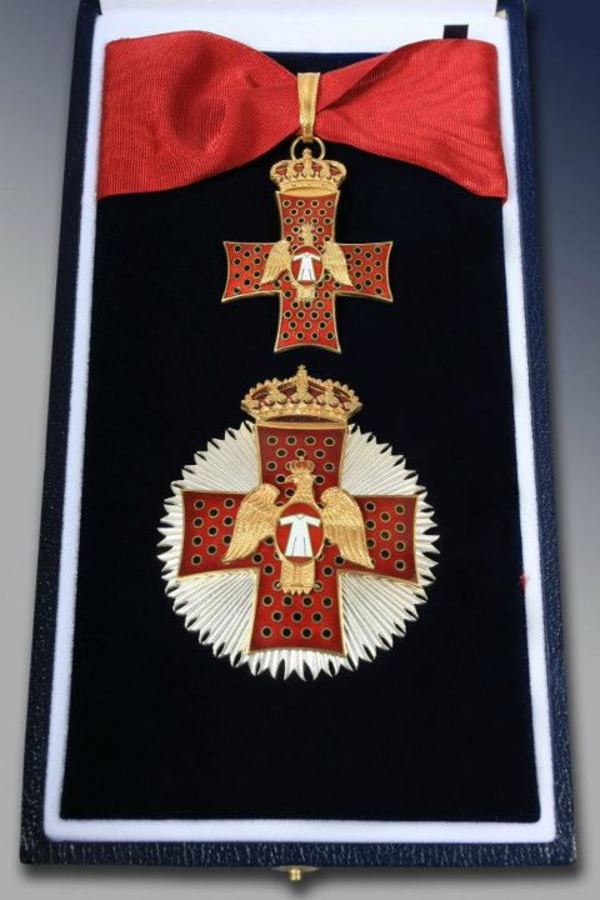
The Order is conferred in five principal grades:
- Knight or Dame
- Knight or Dame Commander
- Knight or Dame Grand Officer
- Knight or Dame Grand Cross
- Knight or Dame Grand Collar
The Order also recognizes the preparatory status of Esquire, which is distinct from its five principal grades.
New members are ordinarily admitted as Knights or Dames. Admission at a higher grade is exceptional and remains within the sole discretion of the Sovereign Grand Master.
Promotion is not automatic. It recognizes sustained service, participation, leadership, good standing, and continued fidelity to the Order and the Royal House.
View the grades and decorations of the Order.
Heraldry and Armorial Matters
Heraldic and armorial matters are administered separately by the Royal Heraldic College of Georgia, the official heraldic authority of the Royal House of Georgia.
This page does not address heraldic privileges, the registration or granting of arms, armorial design, Letters Patent, or the use of the Order’s insignia in connection with personal arms.
All questions concerning these subjects should be directed to the Royal Heraldic College of Georgia.
Visit the Royal Heraldic College of Georgia.
A Living Tradition of Service
The Order of the Eagle of Georgia preserves the history and dynastic traditions of the Georgian monarchy while addressing the needs of the present.
Its significance is not measured solely through ceremonies, decorations, or historical associations. It is demonstrated through the conduct of its Knights and Dames, their loyalty to the Royal House, their service within their communities, and their willingness to act when others face hardship, violence, persecution, or exploitation.
Through this union of history, loyalty, responsibility, and service, the Order remains a living institution of the Royal House of Georgia and a modern expression of the obligations of chivalry.
Related Official Pages
- Grades and Decorations of the Order
- Partial Listing of Recipients
- Government of the Royal Orders
- Delegations of the Royal Orders
- History of the Order of Saint Queen Tamar
- Prince Davit and Operation Snow Leopard
- Aisha’s Notebook
- Engagement with the United Nations on Genocide Prevention
Historical Images and Decorations